
- Home
- About Us
- Academics
-
Offices
- Office of the Vice Chancellor
- Office of the Pro Vice Chancellor
- Office of the Treasurer
- Office of the Registrar
- Office of The Dean, School of Agriculture and Mineral sciences
- Office of The Dean, School of Applied Sciences and Technology
- Office of The Dean, School of Life Sciences
- Office of The Dean, School of Management & Business Administration
- Office of the Dean, School of Physical Sciences
- Office of the Dean, School of Social Sciences
- Others
- Research
- Admission
- Campus Life
- Notice Board
- SUCSU
-
Overview
-
Academic
- Program
- Admission
- Session-wise Curriculum
- Student Engagement & Support
-
Research
-
Faculty
-
Student Adviser
-
Former Head
-
Officers
-
Scholarship
-
Activities
-
Announcement
- Notice Board
- News & Events
-
Awards & Honours
- Graduate Student Awards
- Research Awards
- Teaching Awards
- Service Awards
-
Alumni
-
Collaboration
- Academic
- Research
- Student Chapter
-
Contact Us
Faculty Profile
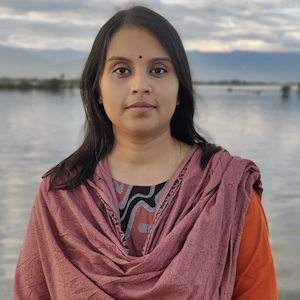
Dr. Mahmuda Sharmin
Professor
Contact Information
- Office Address: Department of Forestry & Environmental Science, Shahjalal University of Science and Technology, Sylhet-3114, Bangladesh
- Phone: +8801671635120
- Email: [email protected], [email protected]
Research Profile Links
Biography
Prof. Dr. Mahmuda Sharmin is committed to extending the understanding of how greenspaces can support multiple ecosystem services in urban areas, including mitigating heat and supporting biodiversity. Her research and professional experience reflect her commitment, notably through her involvement with "Which Plant Where" project, an Australian industry Hort innovation funded project (https://www.whichplantwhere.com.au/). She completed her PhD in Urban Ecology, titled "Urban vegetation: towards cooler, biodiverse cities of the future". She designed, led and executed multiple independent projects in Sydney, NSW, Australia and continues to do so in Bangladesh. This entailed working closely with city councils, Forest department, experts and researchers to make cities inclusive, safe, resilient and sustainable, aligning with SDG 11 and SDG 3.
Education
- 2023: Ph.D. specialized on Urban Ecology, Hawkesbury Institute for Environment (HIE), Western Sydney University, NSW, Australia
- 2018: M.Sc. in Applied Ecology, Christian-Albrecht University of Kiel, Kiel, Germany
- 2011: M.Sc. in Forestry, Dept of Forestry and Environmental Science, Shahjalal University of Science and Technology, Sylhet, Bangladesh
- 2009: B. Sc. in Forestry, Dept of Forestry and Environmental Science, Shahjalal University of Science and Technology, Sylhet, Bangladesh
Research Interests
- Urban Forestry
- Environmental Justice
- Ecosystem services
- Tree growth
Active Research Project
-
1. Tree Growth and Ecosystem Services: A Comparative Analysis of Urban Forest in Major Cities of Bangladesh. Funded by University Research Centre (URC), Shahjalal University of Science & Technology (SUST), Bangladesh (2024-2025) ; FES/2025/1/15
Previous Research Project
- 1. Land use change driven climate change in Bangladesh. Funded by University Research Centre (URC), Shahjalal University of Science & Technology (SUST), Bangladesh (2022-2023)
External Affiliations
- Hawkesbury Institute for the Environment, Western Sydney University, NSW, Australia
Journal Publications
- 1. Urban forests as essential infrastructure for climate resilience and biodiversity: A call to policymakers (2026)
- 2. Climate and socio-economic drivers of urban tree abundance, richness and composition in Australian cities (2026)
- 3. A nation-wide urban trial network of tree and shrub climate resilience (2025)
- 4. Constructing, Mapping, and Analyzing Global Urban Forest Databases Using Hyperlinks: A World of Vast Unevenness and Research Challenges (2025)
- 5. Socio-economic factors, climate, and people’s behaviours determine urban tree health (2025)
- 6. Heat Impact of Urban Sprawl: How the Spatial Composition of Residential Suburbs Impacts Summer Air Temperatures and Thermal Comfort (2025)
- 7. Climate and socio-economic drivers of urban tree abundance, richness and composition in Australian cities (2025)
- 8. Urban greening with shrubs can supercharge invertebrate abundance and diversity (2024)
- 9. Tree Traits and Microclimatic Conditions Determine Cooling Benefits of Urban Trees (2023)
- 10. Tree crown traits and planting context contribute to reducing urban heat (2023)
- 11. Are Diamond’s assembly rules applicable to tropical threatened vascular plants assemblages in the Tarap Hill Reserve in Bangladesh? (2020)
- 12. India in the Oil Palm Era: Describing India’s Dependence on Palm Oil, Recommendations for Sustainable Production, and Opportunities to Become an Influential Consumer. (2019)
- 13. Relationship between Diversity and Productivity at Ratargul Fresh Water Swamp Forest in Bangladesh (2016)
- 14. Tree assemblages and diversity patterns in Tropical Juri Forest, Bangladesh (2015)
- 15. Environmental correlates of vegetation distribution in tropical Juri forest, Bangladesh (2014)
- 16. Disentangling the role of soil in structuring tropical tree communities at Tarap Hill Reserve of Bangladesh (2013)
Teaching
- Forest Restoration Ecology (MSc. Course)
- Forest Soil Management (MSc. Course)
- Forest Ecology
- Tree Physiology
- Social Forestry and Forest Extension
- Forest Botany
- Forest Surveying
Awards & Recognition
- Prime Minister Gold Medal Award
- Erasmus Mundus Masters scholarship for The International Master in Applied Ecology
- Hort Inovation Scholarship for Doctor of Philosophy
Graduate Supervision
- 1. M.Sc. Thesis: Quantifying the Ecosystem Services and Equity of Urban Trees in Sylhet City, Bangladesh. Correspondent: Naeem Bin Mohammad (2025)
- 2. M.Sc. Thesis: Assessing the Impacts of Urbanization on Tree Growth and Anatomical Traits: A Comparative Study of Urban areas of Bangladesh Correspondent: Jannatul Ferdous Rahi (2025)
- 3. M.Sc. Thesis: Assessing the impact of rising temperature on electricity demand: a comparative analysis of urban and rural environments Correspondent: Ahnaf Shahriar (2025)
- 4. B.Sc. Project: Present and Future Distribution of Aquilaria malaccensis in Bangladesh: A species distribution modelling approach Correspondent: Towhidul Islam (2024-2025)
- 5. B.Sc. Project: Trait-Based Adaptive Strategies of Aquilaria malaccensis Under Environmental Gradients in Bangladesh Correspondent: Md. Zahidul Hasan (2024-2025)
- 6. B.Sc. Project: Understanding the variation in Biomass Accumulation Patterns of Agar Trees Across Ecological Zones: Insights for Carbon Sequestration Strategies in Bangladesh Correspondent: Ashik Haldar (2024-2025)
- 7. B.Sc. Project: Measuring the Ecosystem Services of Trees in Sylhet City Using i-Tree Eco Tools Correspondent: Fauziya Fahmida Nishat (2024-2025)
- 8. B.Sc. Project: Land Use Patterns and Tree Species Richness, Abundance, and Diversity in Sylhet City of Bangladesh Correspondent: Sadia Haque Megha (2024-2025)
- 9. B.Sc. Project: Effects of increasing temperature and fluctuating precipitation on urban tree growth in the north-eastern region of Bangladesh Correspondent: Naeem Bin Mohammad (2023-2024)
- 10. B.Sc. Project: Effects of air pollution on urban tree growth (Swietenia macrophylla) and (Samanea saman) in Sylhet City Correspondent: Jannatul Ferdous Rahi (2023-2024)
- 11. B.Sc. Project: Assessing the impact of rising temperature on electricity demand: a comparative analysis of urban and rural environments Correspondent: Ahnaf Shahriar (2023-2024)
- 12. B.Sc. Project: Greenspace in an urban area: Perceptions of local authorities of Sylhet city Correspondent: Tamanna Zaman (2023-2024)
- 13. B.Sc. Project: Land use and land cover change in four city corporations in Bangladesh. Correspondent: Arup Pal (2023-2024)
- 14. B.Sc. Project: Greenspace in Urban Areas: Perception of local authorities of Dhaka city Correspondent: Sharmin Rezwana (2023-2024) Effect of Land Use and Land Cover on Land Surface Temperature and the Role of Tree Shade on Urban Surface Temperature in the North-Western Region of Bangladesh. Correspondent: Kashib Parvez (2022-2023)
- 15. B.Sc. Project: Effect of Land Use and Land Cover and the Role of Tree Shade on Urban Surface Temperature in the North-Western Region of Bangladesh. Correspondent: Kashib Parvez (2022-2023)
- 16. B.Sc. Project: Assessment of land use and land cover changes and their impacts on land surface temperature in the south-western part of Bangladesh Correspondent: Md. Mehedi Hasan (2022-2023)
- 17. B.Sc. Project: Assessing the resistance and resilience of forest ecosystems using remote sensing: A case study in Rema Kalenga Wildlife Sanctuary. Correspondents: Fahim Ahmed (2022-2023)
- 18. M.Sc. Project: Effect of Heatwave on Land Surface Temperature. Correspondent: Kashib Parvez (2023-2024)
- 19. M.Sc. Project: Land surface temperature variations: A comparative study of heat wave days and average days in Dhaka city corporation, M.Sc. Project Correspondent: Md. Mehedi Hasan (2023-2024)
- 20. M.Sc. Project: Impact of land use and land cover change on land surface temperature in the north-eastern region of Bangladesh, M.Sc. Project Correspondents: Fahim Ahmed (2023-2024)
- 21. M.Sc. Thesis: Evaluating Cultural ecosystem services and the influence of socio-economic conditions on people's perception of Urban greenspace Correspondent: Tamanna Zaman (2025): Co-supervised